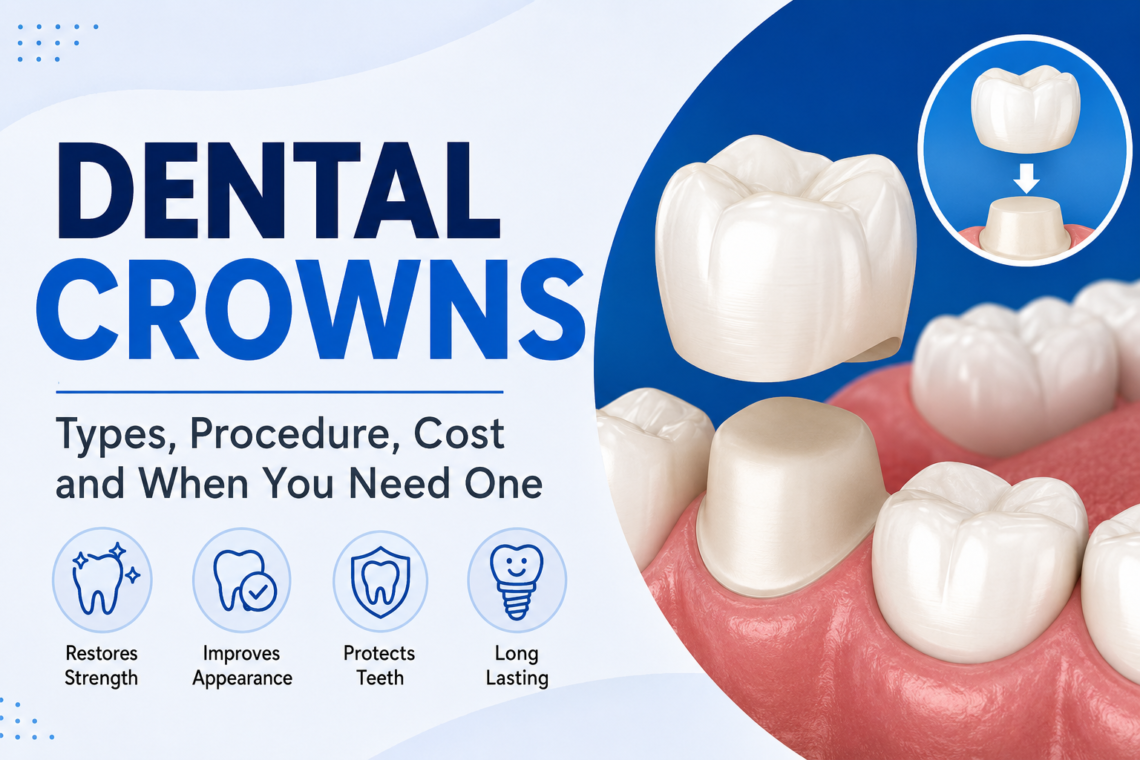
A dental crown is a custom-made cap that fits over a damaged or weakened tooth to restore its shape, strength, function, and appearance. Dentists commonly recommend crowns for teeth that are severely decayed, cracked, broken, worn down, or weakened after root canal treatment. Crowns can also be used to restore dental implants, support bridges, or improve the appearance of certain teeth.
If your dentist has recommended a crown, you may have questions about which type is best, how much it costs, what happens during the procedure, and how long the crown will last.
This guide explains the different types of dental crowns, when you may need one, how the procedure works, what you can expect to pay, and how to care for your crown after treatment.
What Is a Dental Crown?
A dental crown is a tooth-shaped restoration that completely covers the visible portion of a prepared tooth above the gumline.
Unlike a filling, which repairs a specific area of a tooth, a crown covers much more of the tooth. It is generally considered when there is not enough healthy tooth structure remaining for a filling or another more conservative restoration to provide adequate support.
Crowns can be made from several materials, including:
- Metal
- Porcelain
- Ceramic
- Zirconia
- Porcelain fused to metal
- Resin
The best material depends on factors such as the location of the tooth, how much chewing force it receives, how much natural tooth remains, your aesthetic preferences, and your dentist’s assessment.
When Do You Need a Dental Crown?
A crown isn’t automatically required whenever a tooth has a cavity or minor damage. Your dentist will evaluate how much healthy tooth structure remains and whether a filling, inlay, onlay, or another treatment could restore it.
You may need a dental crown if you have:
A severely decayed tooth
When decay has destroyed too much of a tooth for a filling to provide adequate support, a crown can cover and protect the remaining structure.
A cracked or broken tooth
A crown can help hold a weakened tooth together and protect it from further damage, depending on the location and severity of the crack.
A severely worn tooth
Teeth can become worn from grinding, clenching, acid erosion, or other causes. When substantial tooth structure has been lost, a crown may help restore its shape and function.
A large filling
A tooth with a very large filling may have relatively little natural structure remaining. A crown can provide additional protection when the tooth is structurally compromised.
A tooth after root canal treatment
A tooth that has undergone root canal treatment may require a crown to restore and protect it, particularly when significant tooth structure has been lost. However, whether every root canal-treated tooth requires a crown depends on the individual tooth and clinical situation.
A dental implant
A crown can be attached to a dental implant to replace the visible portion of a missing tooth.
A dental bridge
Crowns can serve as supports for some dental bridges, anchoring the bridge to neighboring teeth.
A cosmetic concern
In some cases, crowns can improve the shape, color, or appearance of a severely discolored or misshapen tooth. However, because crowns require alteration of the natural tooth, less invasive cosmetic options may be preferable when appropriate.
Types of Dental Crowns
There isn’t one crown material that is best for everyone. Each option has advantages and limitations.
1. Zirconia Crowns
Zirconia is a strong ceramic material that has become increasingly common in modern dentistry.
Zirconia crowns are known for:
- High strength
- Resistance to chipping and fracture
- Metal-free construction
- Good appearance
- Suitability for many front and back teeth
Zirconia can be particularly useful for teeth that experience substantial chewing forces. However, different zirconia formulations have different properties, including strength and translucency.
The most suitable zirconia crown depends on where the tooth is located and what your dentist is trying to achieve.
Current dental literature and clinical guidance also emphasize that zirconia is not automatically the best choice for every patient. Shade matching, translucency, bonding requirements, bite forces, and the specific restoration all matter.
2. Porcelain or All-Ceramic Crowns
All-ceramic crowns are designed to closely resemble natural tooth enamel.
They can provide excellent aesthetic results because they can be made to match the color and appearance of surrounding teeth.
They are often considered for visible teeth, although modern ceramic materials can also be used in posterior areas depending on the patient’s needs.
The main consideration is that ceramic materials differ considerably in strength and wear characteristics.
3. Porcelain-Fused-to-Metal Crowns
Porcelain-fused-to-metal, commonly abbreviated as PFM, combines a metal structure with a porcelain outer layer.
The metal provides strength while the porcelain gives the crown a more natural appearance.
Advantages include:
- Good strength
- Long history of clinical use
- Natural-looking appearance
- Suitable for front and back teeth
One potential disadvantage is that the porcelain can chip. In some cases, a dark line may eventually become visible near the gumline if the metal becomes exposed or the gums recede.
4. Metal Crowns
Metal crowns can be made from different alloys, including gold-containing alloys and base-metal alloys.
They are highly durable and can tolerate substantial biting forces. They also generally require less removal of healthy tooth structure than some other crown materials.
Their main disadvantage is appearance.
For this reason, metal crowns are often considered for molars and other teeth that are less visible when smiling.
5. Resin Crowns
Resin crowns are generally less expensive than many other options.
However, resin is less durable and more susceptible to wear and fracture than stronger crown materials.
Resin is therefore commonly used for temporary crowns, although resin-based permanent restorations may be appropriate in selected situations.
6. Stainless Steel Crowns
Stainless steel crowns are commonly used for children’s primary teeth and can also have specific temporary applications.
They are prefabricated rather than individually fabricated in the same way as most permanent adult crowns.
For children, stainless steel crowns can protect heavily decayed baby teeth until the natural tooth is eventually lost.
Dental Crown Types Compared
| Crown Type | Main Advantage | Main Limitation | Common Use |
|---|---|---|---|
| Zirconia | Strong and metal-free | Translucency/shade can vary | Front and back teeth |
| All-ceramic | Excellent appearance | Material-dependent strength | Visible teeth |
| Porcelain-fused-to-metal | Strength + aesthetics | Possible porcelain chipping or visible metal margin | Front and back teeth |
| Metal | Very durable | Metallic appearance | Molars |
| Resin | Lower cost | More prone to wear/fracture | Often temporary |
| Stainless steel | Durable and efficient | Not tooth-colored | Children’s teeth/temporary use |
The table is a general guide. Your dentist should select the material based on the specific tooth, bite, remaining tooth structure, gum health, and aesthetic requirements.
Dental Crown Procedure: What Happens?
A traditional crown usually involves two appointments, although some dental offices offer same-day crowns using CAD/CAM technology.
Step 1: Examination
Your dentist first examines the tooth and surrounding tissues.
X-rays may be taken to evaluate the tooth’s roots, surrounding bone, and the extent of decay or damage.
If the tooth has deep decay or an infection affecting the pulp, root canal treatment may be required before the crown is placed.
Step 2: Numbing the Tooth
The dentist uses local anesthesia to numb the tooth and surrounding gum tissue.
This helps keep you comfortable during tooth preparation.
Step 3: Preparing the Tooth
The dentist removes some enamel and damaged tooth structure to create enough space for the crown.
The amount of tooth structure removed varies depending on the type of crown and the condition of the tooth.
If a significant portion of the tooth is missing, the dentist may need to build up the tooth with restorative material so there is enough structure to support the crown.
Step 4: Taking an Impression or Digital Scan
Your dentist takes an impression of the prepared tooth and surrounding teeth.
This can be done using traditional impression material or a digital scanner.
The information is used to design a crown that fits the tooth and works properly with your bite.
Step 5: Temporary Crown
If your permanent crown is being manufactured in a dental laboratory, your dentist may place a temporary crown over the prepared tooth.
The temporary crown protects the tooth while you wait for the permanent restoration.
A traditional laboratory-made crown may take around two to three weeks, although the exact time varies.
Step 6: Permanent Crown Placement
At the second appointment, your dentist removes the temporary crown and evaluates the permanent one.
They check:
- Fit
- Shape
- Color
- Bite
- Contact with neighboring teeth
If everything is satisfactory, the crown is permanently cemented or bonded into place.
Can You Get a Dental Crown in One Day?
Yes, some dental practices offer same-day crowns.
These systems generally use CAD/CAM technology. Instead of taking a traditional impression and sending it to an external laboratory, the dentist can digitally scan the tooth, design the restoration, and mill it in the office.
A major advantage is convenience because the crown may be completed during a single appointment.
However, same-day crowns are not appropriate for every case. Your dentist will determine whether the tooth and restoration are suitable for this approach.
How Much Does a Dental Crown Cost?
The cost of a dental crown varies significantly depending on the country, city, dentist, material, laboratory, complexity of the case, and whether additional treatment is required.
In the United States, current consumer-health sources commonly report roughly $800 to $1,700 or more per crown, although actual prices can be outside this range. WebMD lists approximately $800–$1,700 or more, while Cleveland Clinic notes that crowns can cost around $800–$1,500 or more depending on circumstances.
If you are comparing prices in India, current 2026 clinic-published estimates vary substantially. For example, recent Indian dental sources report ranges around:
- Metal crowns: approximately ₹2,500–₹6,000+
- PFM crowns: approximately ₹4,000–₹8,000+
- Zirconia crowns: approximately ₹7,000–₹15,000+
- E.max/all-ceramic crowns: approximately ₹8,000–₹18,000+
Premium clinics and more complex cases can cost considerably more. These are market examples rather than a universal national price list.
What Can Increase the Cost of a Dental Crown?
The crown itself isn’t always the only treatment included in the final bill.
Your total cost can increase if you also require:
- Root canal treatment
- Core buildup
- Post and core in selected cases
- Gum treatment
- Tooth extraction
- Implant placement
- Bone grafting
- Temporary restoration
- Additional diagnostic imaging
This is why comparing the quoted crown price alone may not provide an accurate picture of your total treatment cost.
Which Dental Crown Is Best?
There is no universally best crown.
The right choice depends on the tooth and your priorities.
For back teeth
Strength is particularly important because molars and premolars experience substantial chewing forces.
Zirconia and metal crowns can be strong options, while PFM and certain ceramic restorations may also be appropriate depending on the case.
For front teeth
Appearance tends to be a higher priority.
All-ceramic or other highly aesthetic materials may provide a natural-looking result, although the specific material should be selected based on the tooth, bite, and restoration requirements.
If you grind your teeth
Tell your dentist if you clench or grind your teeth.
Bruxism can place considerable force on crowns and may increase the risk of damage. Your dentist may recommend a custom night guard in appropriate cases.
How Long Does a Dental Crown Last?
A dental crown does not last forever.
A commonly cited lifespan is approximately 5 to 15 years, although some crowns can remain functional for longer when properly designed, placed, and maintained.
Several factors affect longevity, including:
- Oral hygiene
- Gum health
- Tooth decay around the crown
- Bite forces
- Teeth grinding
- Crown material
- Crown fit
- Eating habits
- Regular dental examinations
A well-maintained crown can last many years, but eventually it may need repair or replacement.
How to Care for a Dental Crown
A crowned tooth still needs regular dental care.
A crown protects the tooth, but it does not make the tooth immune to decay or gum disease.
To protect your crown:
Brush twice a day
Use fluoride toothpaste and a soft-bristled toothbrush.
Floss every day
Pay particular attention to the area where the crown meets the gum.
Plaque can accumulate around the crown margin, and the underlying tooth can still develop decay.
Avoid extremely hard habits
Avoid using your teeth to:
- Open packages
- Bite fingernails
- Chew ice
These habits can damage natural teeth as well as crowns.
Address teeth grinding
If you grind or clench your teeth, discuss it with your dentist.
A custom mouth guard may help protect the restoration during sleep.
Keep regular dental appointments
Routine examinations allow your dentist to check the crown, surrounding gums, and underlying tooth.
What Should You Avoid With a Temporary Crown?
Temporary crowns are not as strong or secure as permanent restorations.
While wearing one, dentists commonly recommend avoiding:
- Sticky candy
- Chewing gum
- Very hard foods
- Extremely chewy foods
Try to chew on the opposite side when possible.
When flossing around a temporary crown, carefully slide the floss out rather than pulling it upward, which can help reduce the risk of dislodging the temporary crown.
Dental Crown Problems and Possible Complications
Crowns are generally successful restorations, but complications can occur.
Tooth sensitivity
Some people experience sensitivity to hot or cold after receiving a crown.
If sensitivity persists or becomes painful, contact your dentist.
Crown feels loose
A crown can sometimes become loose because of problems with the underlying tooth, cement, or restoration.
A loose crown should be evaluated by a dentist.
Crown chips or cracks
Certain materials can chip or fracture, particularly when subjected to heavy forces.
Decay underneath or around the crown
A crown does not prevent cavities.
If bacteria reach the underlying tooth around the crown margin, decay can develop.
Gum irritation
An improperly fitting crown or plaque accumulation around the restoration can contribute to gum irritation.
Bite feels different
Your crown should fit comfortably with your natural bite.
If the tooth feels unusually high when you bite down, tell your dentist so the bite can be evaluated and adjusted if necessary.
What Happens If a Dental Crown Falls Out?
If your permanent crown falls out, don’t ignore it.
Keep the crown in a safe place and contact your dentist as soon as possible.
Your dentist may be able to clean and re-cement the crown if the restoration and underlying tooth are still suitable. In other cases, a new crown or additional treatment may be necessary.
Avoid chewing on the affected tooth until you’ve received professional advice.
Dental Crown vs. Filling
A filling is generally used when there is enough healthy tooth structure remaining to restore the damaged area.
A crown covers much more of the tooth and is generally considered when the tooth is too weak or structurally compromised for a filling alone.
For smaller cavities, a crown may be unnecessarily extensive.
For severely damaged teeth, however, a filling may not provide enough protection.
Your dentist will determine which restoration is appropriate based on the amount of remaining tooth structure.
Dental Crown vs. Onlay
An onlay is a restoration that covers part of a tooth rather than completely covering it.
It can be useful when a tooth has more damage than a filling can repair but still has enough healthy structure that a full crown may not be necessary.
This makes onlays a more conservative option in selected cases.
Dental Crown vs. Veneer
Crowns and veneers serve different purposes.
A veneer is a thin layer bonded primarily to the front surface of a tooth, while a crown covers the tooth much more extensively.
Veneers are often used for cosmetic concerns such as certain discoloration, shape, or spacing issues.
Crowns are generally used when a tooth needs significant structural protection or restoration.
Because a crown requires more alteration of the natural tooth, it should not automatically be chosen for a purely cosmetic problem when a more conservative option can achieve the desired result.
Frequently Asked Questions About Dental Crowns
Is getting a dental crown painful?
The tooth is normally numbed with local anesthesia during preparation, so you should not feel the drilling itself. Some sensitivity or soreness can occur after treatment. Persistent or severe pain should be evaluated by your dentist.
How long does a dental crown procedure take?
A traditional crown generally requires two appointments. The first appointment involves examination and tooth preparation, followed by impressions or scanning and placement of a temporary crown. The permanent crown is then fitted at a later appointment.
Some practices offer same-day crowns using CAD/CAM technology.
How long does a dental crown last?
Dental crowns commonly last around 5 to 15 years, although some can last longer with proper care. Oral hygiene, bite forces, grinding, crown material, and the condition of the underlying tooth all influence longevity.
Can a crown get a cavity?
Yes. The crown itself cannot develop a cavity in the same way natural enamel can, but the natural tooth underneath or around the crown can develop decay.
Can you eat normally after getting a crown?
Once the permanent crown has been properly placed and your dentist gives you clearance, you can generally return to normal eating. You may need to be more cautious immediately after treatment and while wearing a temporary crown.
Is zirconia better than porcelain?
Not necessarily. Zirconia is generally very strong and can be an excellent option for many teeth, while certain ceramic materials may provide superior aesthetics for particular cases. The best choice depends on the location of the tooth, bite, appearance, remaining tooth structure, and the specific material being considered.
Do all root canal-treated teeth need crowns?
Not every root canal-treated tooth automatically requires a crown. The need depends on factors such as the tooth’s location, remaining structure, and how much damage has occurred. Your dentist should assess the individual tooth.
Can a dental crown be whitened?
Whitening treatments change the color of natural teeth but generally do not change the color of an existing crown. If you are considering whitening, discuss it with your dentist before choosing the final crown shade.
What happens if I don’t get a crown when my dentist recommends one?
That depends on why the crown was recommended. A severely weakened tooth may be at greater risk of fracture or further damage without appropriate protection. In some situations, another restoration may be possible. Ask your dentist what alternatives are available and what could happen if treatment is delayed.
The Bottom Line
A dental crown is more than a cosmetic “cap.” It is a restorative treatment designed to protect and rebuild teeth that have suffered significant structural damage.
Crowns can be made from zirconia, ceramic, porcelain-fused-to-metal, metal, resin, and other materials, with each option offering different advantages in strength, appearance, durability, and cost.
The procedure traditionally takes two appointments, although same-day CAD/CAM crowns are available in some dental offices. Costs vary widely depending on the material, location, dentist, laboratory, and additional treatments required.
The most important decision isn’t simply choosing the cheapest or most expensive crown. The right restoration is the one that provides an appropriate balance of strength, appearance, longevity, tooth preservation, and cost for your particular tooth.
If your dentist recommends a crown, ask why you need it, what alternatives are available, which material they recommend, how long it is expected to last, and what the complete treatment will cost before proceeding.
Medical note: This article is for general educational purposes and does not replace an examination or diagnosis by a dentist. The appropriate type of crown and treatment plan depend on your individual oral health.