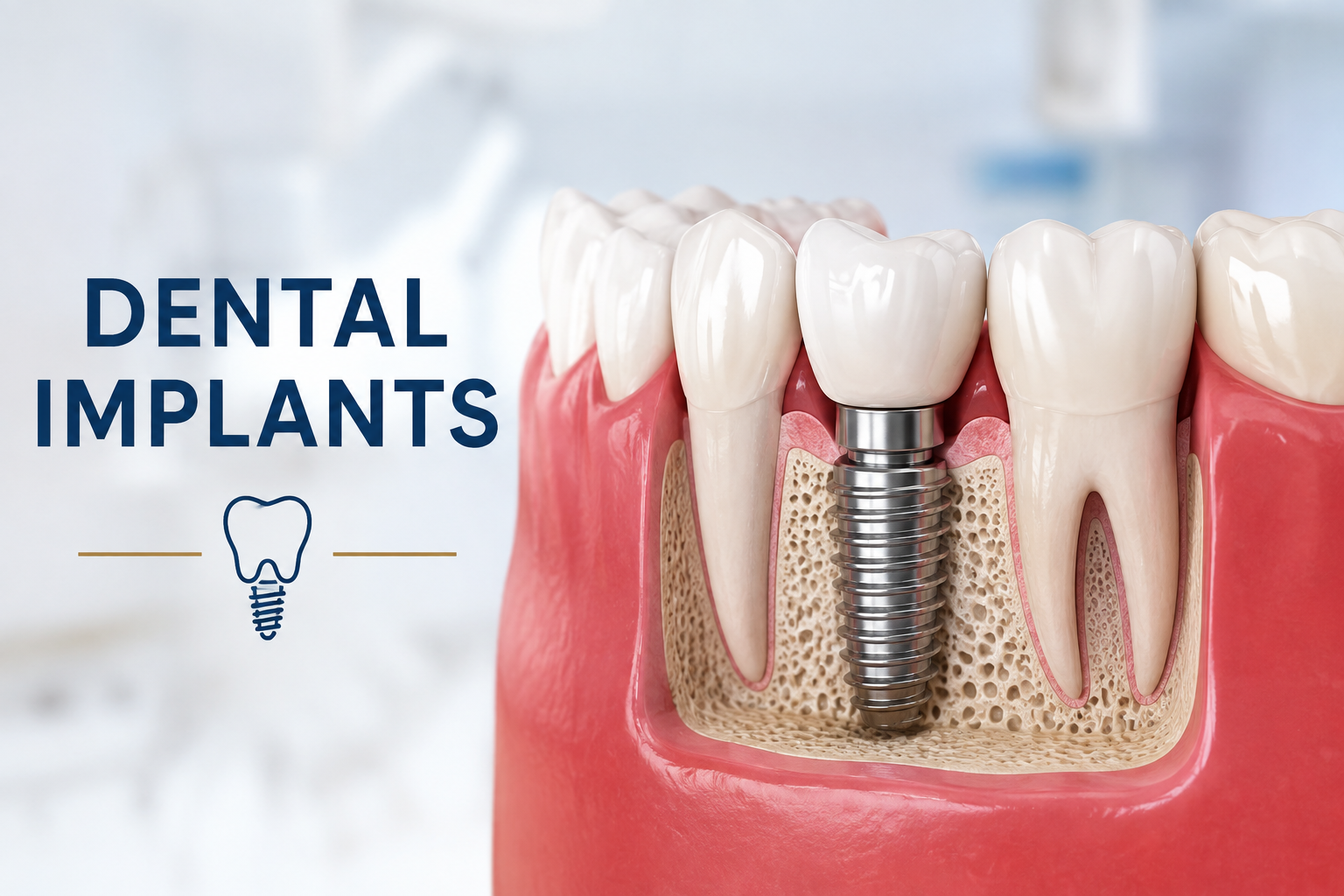
Dental implants – A Long-Term Option for Tooth Replacement
As opposed to sitting on top of other teeth as a bridge or sitting on the gums like dentures, dental implants are placed into the jawbone, where they act as an artificial root for crowns, bridges and dentures. They can restore chewing function, improve the appearance of a smile and provide a strong and stable solution for missing teeth.
Dental implants can restore chewing function and improve your smile by replacing missing teeth with a stable, long-term tooth replacement.
Suitability depends on several factors, including the number of teeth a patient is missing, the condition of the jawbone, the health of the gums and the overall health of the patient. Smoking or the use of any form of tobacco is also taken into consideration, as is the type of treatment that will be used to replace the missing teeth.
What Are Dental Implants?
A dental implant is a small post, usually made from titanium and, in some cases, ceramic such as zirconia, that is surgically placed into the jawbone to replace the root of a missing tooth.
Most dental implants will be completed with a dental crown, dental bridge or denture. There are three main components to a dental implant, listed below.
- Implant: The implant is the small post, usually made from titanium or another biocompatible material, that is placed into the jawbone to replace the tooth root.
- Abutment: This is a connector that is attached to the implant and is used to support the tooth or teeth attached to it.
- Restoration: Dental implant crowns, dental bridges or implant-supported dentures.
Once the dental implant has successfully integrated into the jawbone, the dental restoration can be attached to the implant using the abutment.
It is through a process called osseointegration that the dental implant integrates with the surrounding bone. Dental implants become firmly anchored in the jaw, allowing for the stable attachment of the dental implant restoration.
How Do Dental Implants Work?
When a tooth is lost, it has a root in the jawbone of the patient. In order to replace a tooth, a dental implant is placed into the jawbone in the place where the root of the tooth would be.
This bond between the jawbone and the surface of the dental implant helps provide stability for the replacement tooth. To support a dental crown, bridge or other restoration, the dental implant first has to be placed into the jawbone. The jawbone then gradually bonds to the surface of the dental implant.
The final restoration, such as a single crown, bridge or implant-supported denture, is then attached to the dental implant through the abutment.
The number of dental implants required can vary depending on the patient and the type of restoration being planned. The dentist can assess the situation and recommend the best number of implants to ensure the patient receives the most effective dental restoration. Some patients may require a single dental implant while others may need several to be able to wear their replacement teeth with confidence.
What Are the Parts of a Dental Implant?
Understanding the treatment of dental implants and the three major components that make up a dental implant.
Implant Post
The implant post replaces the root of the missing tooth. The post is placed in the jawbone, just as a tooth’s root would be.
Titanium is the material most commonly used for dental implants because it is biocompatible and can integrate with bone. However, dental implant systems can also be made of ceramic materials, such as zirconia.
Abutment
The abutment is a connector that supports the crown or other dental restoration above the gum line. The abutment connects to the dental implant, which is placed in the jawbone below the gum line.
The abutment can be attached to the dental implant at the time of placement of the dental implant or at a later date as part of the dental implant procedure.
Crown, Bridge or Denture
A single implant can support a dental crown, while multiple implants can support a bridge or full-arch restoration.
Implants can be used for single tooth replacement using crowns, for two or more missing teeth using bridges, and even for a full arch of missing teeth using dentures.
Types of Dental Implants
There are different types of dental implants and implant restorations, which makes treatment highly individual. The dentist or implant specialist considers the bone, gums, teeth and desired restoration for each patient when determining the most appropriate treatment.
Endosteal Implants
Endosteal implants are the most common form of dental implants. They are surgically placed into the jawbone and may have a screw-like or cylindrical design. Endosteal implants are used when there is sufficient healthy bone to support the dental implant.
Endosteal dental implants are used to anchor a dental implant into the bone of the jaw, with enough support to hold the dental implant. The dental implant itself is typically a screw-like cylinder that is anchored into the bone.
Subperiosteal Implants
A subperiosteal dental implant is positioned under the gum but above the jawbone.
Subperiosteal implants may be considered for some patients with insufficient bone for conventional implants when other treatment options are not suitable.
Single-Tooth Implants
The term Single-Tooth Implant refers to a Dental Implant used to support a single crown for a missing tooth.
Single-tooth dental implants allow for the natural adjacent teeth to remain untouched and not prepared for a dental bridge.
Implant-Supported Bridges
For situations where there are several adjacent teeth missing from a patient’s mouth, dental implants can be used to support a dental bridge. This approach will need to have fewer natural teeth prepared and crowned to support the dental bridge than would be the case for a tooth-supported bridge.
Using dental implants to support a bridge means that fewer implants are required to complete a dental restoration than with individual tooth implants.
Full-Arch Dental Implants
Full-arch dental implants are designed for patients missing all teeth in an upper arch or a lower arch. Strategically placed dental implants are used to support a fixed or removable, full-arch dental restoration.
The number and position of implants used for a full-arch restoration depend on the patient’s anatomy and the treatment plan. Multiple strategically placed implants can support a fixed or removable full-arch restoration.
Titanium vs Zirconia Implants
Titanium is by far the most established material used for dental implants. This material is biocompatible, allows for osseointegration and for this reason it is used for dental implants in most parts of the world.
Zirconia implants are made from a ceramic material and offer a metal-free option in appropriate cases.
The choice between titanium and zirconia should be based on factors such as the treatment site, bone and gum conditions, restoration requirements and clinical considerations, rather than appearance alone.
Who Is a Good Candidate for Dental Implants?
Dental implants may be suitable for many adults who have lost one or more teeth for a variety of reasons. To have dental implants placed within the jaw, a patient must have sufficient healthy bone to support an implant.
Good oral health is crucial for dental implant treatment. Active gum disease and untreated dental problems generally need to be addressed before implant placement.
A dentist will also consider:
- The amount and quality of available jawbone
- Gum health
- The number and location of missing teeth
- Overall health
- Smoking or tobacco use
- Conditions that may affect healing
- Medications and medical history
- Ability to maintain good oral hygiene
Patients with significant bone loss may sometimes be treated with bone grafting before implant placement, although the graft needs time to heal and develop sufficient support.
Who May Not Be a Good Candidate for Dental Implants?
Dental implants are not automatically suitable for everyone.
However, having a medical condition does not automatically rule out implant treatment. The dentist will review the person’s overall health, medication and ability to heal before deciding whether or not to go ahead with dental implant treatment.
While dental implants are generally a healthy option for people with health problems, the dentist treating you will need to take into account your general health, any medication you are taking and how you will heal from your treatment.
How Are Dental Implants Done?
Dental implants are generally provided in stages. The stages depend on individual circumstances and the type of dental implant treatment being provided.
1. Initial Consultation
Step 1 – Initial Dental Consultation
The dentist examines the missing tooth or teeth, the gums and the other teeth in the jaw to determine whether they are suitable for implant treatment. X-rays and, when needed, 3D imaging may be used to evaluate the jawbone. This allows the dentist to view the jawbone where the dental implants will be placed as well as the location of nerves, sinuses and other important structures in the jaw.
Dental implant treatment can be used to treat one missing tooth or several missing teeth, depending on the treatment plan.
2. Tooth Extraction When Necessary
If there are teeth on either side of the space left by the missing tooth, those natural teeth will also need to be assessed before implant treatment can proceed. If necessary, tooth extraction may be required before dental implant placement can take place. This could be because the tooth has become badly decayed or has become infected.
In some cases, it is possible to place a dental implant at the same time as tooth extraction. In other cases, it may be necessary to allow the extraction site to heal first before placing dental implants.
Each situation with a tooth or teeth to be removed is different from the others and must be evaluated in its own light.
3. Bone Grafting When Needed
An implant requires sufficient healthy bone for stability.
After a tooth has been removed from the dental arch, the residual jawbone may be too thin, too soft or have lost too much volume. In this case, a bone graft may be recommended before the dental implant can be placed. The bone graft serves as the foundation for the dental implant.
The time needed for healing before a dental implant can be placed varies depending on the type of bone grafting and the patient’s individual circumstances. While some methods can heal in a few months, others require more time before the dental implant can be placed. In some cases, the dentist can place grafting material at the same time as the dental implant.
A sinus lift is a procedure that raises the sinus floor to create sufficient bone height for dental implants when there is not enough bone beneath the sinus.
4. Implant Placement
Note: A local anesthetic will usually be used for the procedure. Sometimes, though, patients will be sedated for the treatment. For dental implants, a gum incision is usually made to expose the jawbone. The dentist then creates an opening in the bone, places the implant and closes the gum using sutures.
Once the gum has been lifted to expose the jawbone below, a small opening is made in the jawbone and the implant placed inside the jaw. The gum is closed back into place.
Temporary teeth may be provided while the implants are healing, depending on the treatment plan.
5. Osseointegration
The jawbone then begins to bond with the dental implant.
This allows bone to grow around the dental implant and helps it become firmly fixed in the jawbone. This process is known as osseointegration.
The amount of healing time that is required before your dental implants can be loaded with a crown can vary depending on a variety of factors. The jawbone needs to fully integrate with the dental implant through a process called osseointegration. This can take about 3–9 months, depending on how quickly the body heals.
6. Abutment Placement
After sufficient osseointegration has taken place, the abutment can be attached to the dental implant. Some dental implant systems are attached during the initial surgery, and others may require a second minor procedure, which may require additional healing time for the gums before the final restoration is put in place.
Attaching the abutment to the dental implant is a step in the dental implant process. The abutment can be attached at the time of the dental implant surgery. However, there are different dental implant systems, and some need a second dental procedure to attach the abutment.
Time may be required for the gum to heal around the abutment before the final restoration is completed and placed.
7. Placement of the Final Tooth
The final tooth for a single dental implant is usually a crown that is custom-made for the patient and designed to match the surrounding teeth in shape, size and color. Once ready, the final tooth is placed in the patient’s mouth.
A single dental implant can be restored with a crown. The crown will be specifically made for your mouth with the missing tooth in mind as well as the surrounding teeth in terms of shape, size and color.
With a dental implant in place, the restoration can function similarly to a natural tooth. A single dental implant is completed with a crown. Implants can also be used with bridges or even dentures.
Dental Implant Surgery Timeline & Treatment Length
Dental implant treatment time varies from person to person.
In the meantime, the jawbone will have begun to heal into the dental implant. This may be completed within a few months for the surgical placement of an individual dental implant. The overall treatment time is therefore often several months.
Treatment may take longer when the patient needs:
- Tooth extraction
- Bone grafting
- Sinus augmentation
- Treatment for gum disease
- Multiple implants
- Full-arch restoration
Temporary teeth can be fitted into your mouth for the period of time required for the dental implants to heal. This will depend on the situation and treatment plan for the dental implant in question.
What Are the Benefits of Dental Implants?
There are many potential benefits of dental implants when they are properly planned and maintained.
They Can Restore Chewing Function
Dental implants can help restore chewing function after treatment and healing. In addition, patients are able to speak properly without having to worry about their dental work shifting while they speak.
They Can Improve Speech
Speech can be affected by missing teeth or dentures that do not fit properly, and a stable implant-supported restoration may improve speech.
They Look Similar to Natural Teeth
Missing teeth can be replaced with dental implants and dental crowns that can be color-matched to the surrounding teeth.
They Can Help Preserve Jawbone
The bone that previously supported a missing tooth can gradually shrink after tooth loss. Dental implants are designed to sit in the jawbone, just like the roots of natural teeth do. Once integrated into the jawbone, dental implants can help preserve bone in the area.
They Do Not Require Neighboring Teeth for Support
A single dental implant can replace a missing tooth without requiring the neighboring healthy teeth to be reduced to support a conventional bridge.
They Can Provide Long-Term Tooth Replacement
Dental implants are a long-term solution for tooth loss. With proper care, good oral hygiene, regular dental check-ups and maintenance, dental implants can last for many years. The dental implant itself may last a lifetime; however, the crown, bridge or denture attached to the implant may require repair or replacement over time.
What Are the Risks of Dental Implants?
As with any surgery, dental implant surgery can also have complications.
Possible risks include:
- Infection around the implant
- Damage to nearby teeth or structures
- Nerve injury
- Pain, numbness or tingling
- Sinus complications with some upper-jaw implants
- Implant movement or failure to integrate with bone
- Bone loss around an implant
- Inflammation around the implant
Smoking and poor oral hygiene can increase the risk of complications. Dental implants take time to heal, and smoking can interfere with healing and increase the risk of implant-related complications.
Implants that do not integrate with the bone may need to be removed, and retreatment may be considered after healing.
Is Dental Implant Surgery Painful?
Local anesthesia is usually used during dental implant surgery to numb the treatment area. Sedation may also be used when appropriate.
After dental implant surgery, patients can experience some discomfort, swelling, bruising and minor bleeding. These symptoms generally improve as the surgical site heals.
The amount of discomfort varies from patient to patient. It can depend on factors such as the number of implants placed and whether additional procedures, such as bone grafting, are required.
Note that if pain, swelling or other symptoms worsen instead of getting better, then it is best to contact the dentist or the surgeon that performed the dental implant surgery.
What Is Recovery Like After Dental Implant Surgery?
This healing time allows the bone around the dental implant to heal.
When your dental implant surgery has completed, you will be given a list of suggestions for eating during the initial healing stage. These suggestions may include eating soft foods. You will also be given suggestions on how to brush and clean your dental implants and any other medications that you may need.
The amount of discomfort varies from case to case. Some swelling, soreness, and bruising as well as minor bleeding can occur in the days following the procedure. Follow-up appointments allow the dentist or surgeon to check the healing of the implant site.
The healing time for dental implants varies depending on several factors including the individual’s healing ability. Implant integration usually takes several months, although the exact healing time varies.
How Long Do Dental Implants Last?
Dental Implants: A Long-Lasting Solution for Tooth Loss.
With proper care and good oral hygiene, your dental implants can last for many years. They may last a lifetime with proper care and maintenance. However, the visible restoration, or crowns and bridges, will need to be replaced from time to time. The lifespan of these can vary depending on the material, how they are used and how well they are maintained.
As with natural teeth, dental implants can be durable and last for many years; however, the dental restoration, such as crowns and bridges, that are attached to the dental implants typically do not last as long as the dental implant itself. Crowns and bridges may need to be replaced over time, depending on factors such as wear and tear, the materials used and oral care.
How Much Do Dental Implants Cost?
The cost of dental implants can vary depending on a number of factors, including location, country, dentist/specialist, implant, abutment, crown and case complexity.
The cost of a single dental implant can vary greatly. For a U.S.-focused article, an indicative price range should be presented only when supported by current local pricing data, because fees vary by location, provider and case complexity.
Costs for dental implants can vary greatly depending on the country, state, dentist, implant system, and other factors. This article gives a general overview of the costs for single tooth dental implants. Any prices published for dental implants should be dated and checked against current U.S. pricing data before publication.
What Is Included in the Cost?
A dental implant quote from a dentist or specialist may include some of the following elements:
- Initial examination
- X-rays or 3D imaging
- Tooth extraction
- Implant placement
- Implant post
- Abutment
- Crown or other restoration
- Temporary restoration
- Follow-up appointments
In addition to the listed procedures, a practice may charge for further procedures, for example a bone graft or a sinus lift.
What Factors Affect Dental Implant Cost?
Several factors can influence the final price:
Number of teeth to be replaced: This is one of the primary cost-determining factors. Replacing one tooth, for example, is generally less expensive than replacing several teeth or an entire dental arch.
The type of dental work required: Implant material and system. Prices for dental implants can vary depending on the dental implant system and materials that are used for the dental implant and for the rest of the dental work.
Bone grafting: This builds bone and usually adds to the overall treatment cost.
Sinus lift: Additional expenses for the surgical procedure, to make room for the dental implant in the upper jaw.
Location: Dental fees can vary substantially between cities, regions and countries.
Provider experience: How much will the implant specialist charge, and how much will the treatment cost at the facility where it is carried out? This should be clearly set out in an itemized treatment estimate.
An important consideration in determining the cost for dental implants is the amount of bone available to support the root of the dental implant. Often there is not enough natural bone in the jawbone, and as a result, a bone grafting procedure is necessary. The bone grafting procedure is a separate surgical procedure and as a result, will add to the overall cost for the dental implant treatment.
Are Dental Implants Covered by Insurance?
Dental insurance coverage varies widely.
Each dental plan covers a different portion of the dental implant treatment. Some plans will cover portions of dental implant treatment while others will not cover any of the treatment. In some cases, the dental plan may cover a different portion of the crown than the rest of the dental implant treatment.
Each dental insurance plan will be different and you will need to determine what portion of the dental implant treatment will be covered by your dentist or oral surgeon and your dental insurance plan.
Dental Implants vs Bridges vs Dentures
Dental implants are not the only way to replace missing teeth.
Dental Implants
Dental implants are anchored into the jawbone and can support crowns, bridges or implant-supported dentures.
Potential advantages:
- Stable tooth replacement
- Natural-looking appearance
- Can help preserve jawbone
- Does not require neighboring teeth to support a single implant crown
Potential disadvantages:
- Requires surgery
- Treatment can take several months
- Usually costs more initially than some alternatives
- May require bone grafting
Dental Bridges
- Conventional bridges are fixed solutions which are supported by neighboring teeth.
Dental bridges may be completed in a shorter timeframe than implants in some cases, although the timeline varies by treatment, and with a tooth-supported bridge, the adjacent teeth are prepared for the dental work to ensure the proper support for the dental bridge.
Dentures
Dentures are removable prosthetic teeth which can be used to replace several teeth or all of the upper and lower teeth.
Conventional dentures can shift while a patient is eating or speaking; however, implant-supported dentures are another option. These are used in conjunction with dental implants fixed into the jaw.
The most appropriate dental solution depends on various factors that can affect the overall treatment outcome. These can include the general health of a patient’s teeth and mouth, the amount of bone left in a patient’s jaw, the cost of the proposed dental solution, the patient’s preferences and goals for the dental treatment.
How to Care for Dental Implants
Dental implants still require daily care.
Good implant maintenance includes:
- Brush your teeth regularly
- Clean between the teeth and around the implant
- Follow your dentist’s instructions for flossing or interdental cleaning
- Attend regular dental examinations
- Have professional cleanings when recommended
- Avoid using your teeth to open packages, to bite into hard objects, etc.
- Treat teeth grinding (bruxism) if it is affecting the dental implant
- Avoid tobacco products
Although the implant itself cannot develop cavities, the gums and bone surrounding it can develop disease. Thus, good care of dental implants is important for long-term oral health.
When Should You Contact Your Dentist After Getting an Implant?
Contact your dental provider if you notice symptoms such as:
- A loose or moving implant
- Persistent or increasing swelling
- Bleeding gums
- Pus around the implant
- Fever
- Significant or worsening pain
- Swollen lymph nodes accompanied by other signs of infection
These symptoms may require professional evaluation.
Frequently Asked Questions About Dental Implants
How long does it take to get a dental implant?
Time required for dental implant treatment varies depending on each case. Most dental implant treatments require several months for healing of the jawbone around the dental implant and finally attaching the final tooth restoration to the dental implant.
Are dental implants permanent?
Dental implants are long-lasting tooth replacements. The implant itself can last for many years and may last a lifetime with proper care. However, the crown, bridge or denture attached to the implant may need to be repaired or replaced over time.
How painful are dental implants?
Pain, swelling and soreness in the jaw, face and gums can occur during recovery and should improve as healing progresses.
Can you get dental implants if you have bone loss?
Even with slight bone loss, there may be sufficient bone to place a dental implant. In some cases, a bone graft is required to build up the dental implant site before the actual dental implant can be placed.
Can smokers get dental implants?
Smoking after dental implant surgery can interfere with healing and increase the risk of complications or implant failure. Your dentist can advise you about stopping tobacco use before and after surgery.
What is the success rate of dental implants?
Dental implants generally have favorable outcomes, but success depends on factors such as bone, gum health, oral hygiene, smoking and overall health. The dental implant needs sufficient bone for integration. Your gums will also need to be healthy enough. You will also need to maintain good oral hygiene. In addition, smokers can increase the risk of complications. Your overall health will also play a large role in the success of your dental implant.
Can dental implants replace all missing teeth?
Dental implants can be used for a full arch of missing teeth. Full-arch implant treatment can involve several dental implants placed in strategic locations throughout the dental arch to support a fixed or removable restoration.
Are dental implants better than dentures?
When discussing dental implants, many patients compare them to dentures, and it is true that dental implants can offer a long-term solution to missing teeth, while dentures are another treatment option that may be suitable for some patients. In reality, however, there is no right or wrong answer, as both options can be suitable for patients with missing teeth, depending on their individual circumstances.
How do you know if you need dental implants?
Dental implants may be an appropriate solution for individuals who have one or more missing teeth. First, however, a dental examination needs to be conducted in order to find out whether there is sufficient bone for an implant and whether the gums as well as the rest of the patient’s oral health are suitable for an implant.
The Bottom Line
Dental Implants are designed as a long-term tooth replacement option. A dental implant is used as a foundation for a single tooth crown, a dental bridge or even for a full denture. Dental implants are placed into the jawbone where they are left to heal for a period of time. During this time the jawbone will start to grow into and around the implant. After this period of time the crown, bridge or denture is placed on top of the implant.
In addition to offering long-term solutions for missing teeth, by recreating the function of a tooth root, dental implants also have a number of potential drawbacks. Most notably, dental implants are a surgical procedure that, in addition to requiring careful planning, will also require patients to carry out appropriate oral care in order to ensure the continued success of their treatment.
Each dental patient has individual requirements for dental implants, including the cost and time needed for treatment. Additional dental treatment, such as tooth extraction, bone grafting or a sinus lift, may be required before placing dental implants.
As always, we recommend that you first get a check-up with a qualified dentist, who can examine your teeth, gums and jawbone, assess your oral health and recommend suitable dental treatments.